
"Cell," "module," and "pack" get used interchangeably in a lot of sales literature, and that's where a lot of sizing mistakes start. An integrator asking for "200 cells" and an integrator asking for "a 200-cell pack" are describing two different scopes of work — one is a bag of parts, the other is a finished, wired, protected product. This article breaks down the three levels, shows the math behind pack voltage using a real LiTrue cell and pack as a worked example, and explains where module-level assembly earns its keep and where it just adds weight.
What Is a Battery Cell?
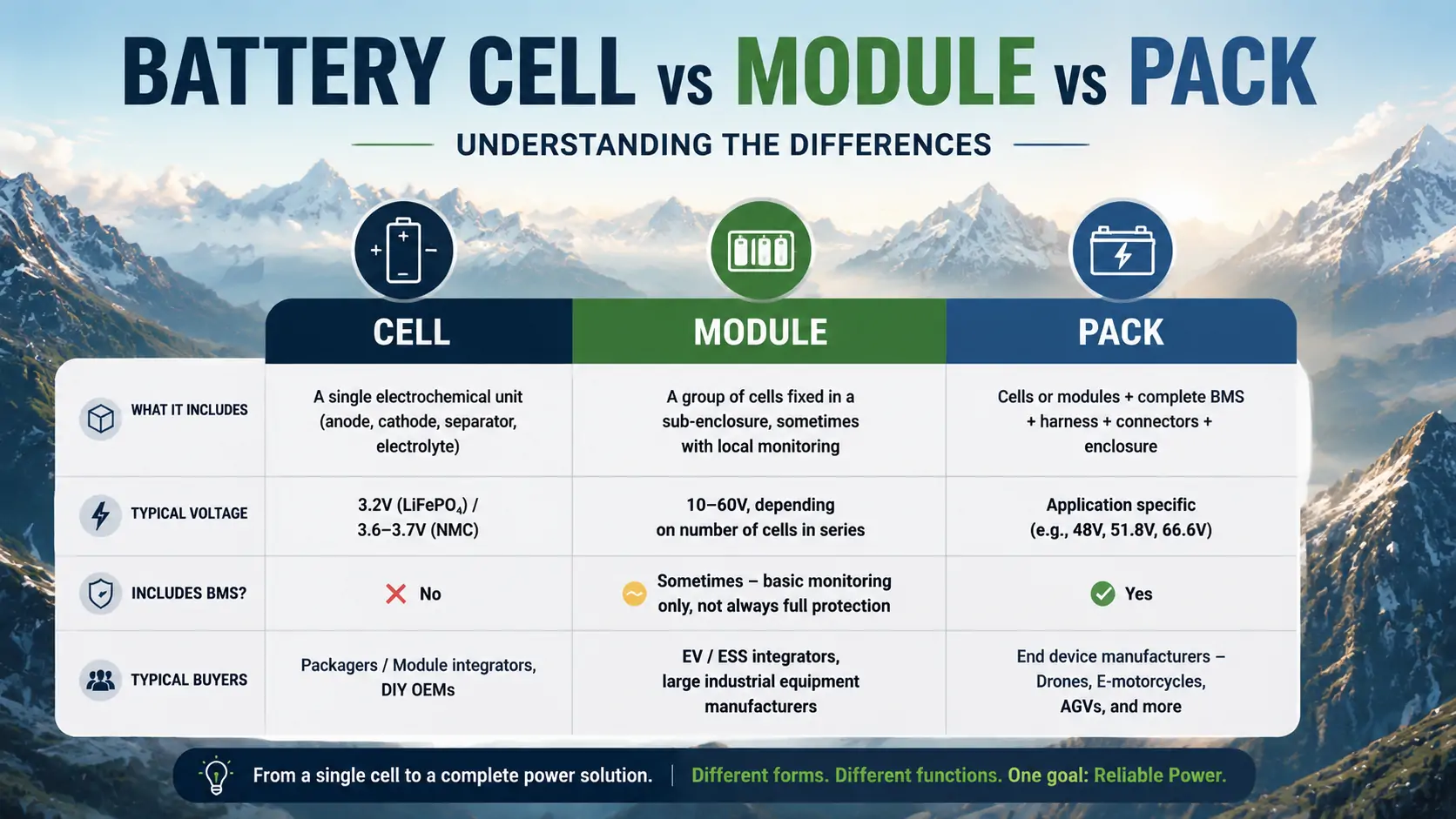
A cell is the smallest electrochemically complete unit — anode, cathode, separator, and electrolyte sealed into a single case, producing one nominal voltage on its own. It's the raw building block everything else is made from. A cell by itself has no BMS, no external enclosure, and no protection circuit; it's just electrochemistry in a container.
Format matters here. A pouch cell uses a flexible foil laminate, which keeps weight down and allows custom form factors — the reason most UAV batteries lean on LFP or NMC pouch cells rather than rigid cylindrical formats. Nominal voltage depends on chemistry: LFP cells sit around 3.2V nominal, NMC cells around 3.6–3.7V. That 0.4–0.5V difference doesn't sound like much, but it changes the series count needed to hit a target pack voltage, which is where a lot of "why don't these numbers match the datasheet" questions come from.
LiTrue PA50N-P is a concrete example of what a real cell datasheet looks like at this level — no BMS, no enclosure, just the electrochemical unit and its performance envelope:
| Parameter | PA50N-P (NMC pouch cell) |
|---|---|
| Classification | High C-rate |
| Cell structure | Stacked pouch cell |
| Nominal capacity | 50.0Ah |
| Nominal voltage | 3.70V |
| Energy density | 226Wh/kg |
| Max. continuous discharge | 3C (≈150A) |
| Max. pulse discharge | 8C (≈400A) |
| Cycle life | ≥2000 @ 1C/3C |
| Operating temperature | -43°C ~ +55°C |
| Dimensions (T×W×H) | 10.0 × 161 × 232mm |
What Is a Battery Module?
A module is a small group of cells — usually a fixed series/parallel arrangement — mechanically fixed into a sub-enclosure, sometimes with a basic monitoring or balancing board attached. Think of it as a pre-built, pre-tested brick: instead of wiring 200 individual cells into a pack, you wire together 10 modules of 20 cells each.
Modules exist for three practical reasons: they isolate a manufacturing defect to a smaller, replaceable unit instead of the whole pack; they give large-format packs (EV, BESS, forklift) a standardized mechanical building block that's easier to service and requalify; and they simplify thermal management, since a module can carry its own cooling interface rather than relying on the full pack enclosure to manage every cell individually.
Here's the trade-off worth being honest about: modules add mass and joints. A lot of UAV and small industrial packs skip the module layer entirely and go straight from cell to pack, because the extra housing and interconnects a module layer adds are dead weight on something that has to fly. Module-level assembly is a BESS and EV pattern more than a drone pattern.
What Is a Battery Pack?
A pack is the finished, deployable product — cells (or modules) plus a BMS, wiring harness, output connectors, and an enclosure, delivering a specific voltage and capacity at a set of terminals a customer can actually plug into a drone, e-bike, or piece of equipment. This is the level where certifications, connector choice, and protection circuitry all come together into something you can ship.
LiTrue UAV-JP330L is a working example of what "pack" means in practice — not a bundle of cells, but a complete, certified assembly:
| Parameter | UAV-JP330L (finished pack) |
|---|---|
| Configuration | 1P18S (18 cells in series, 1 in parallel) |
| Chemistry | NMC |
| Nominal capacity | 30Ah |
| Nominal energy | 1.998kWh |
| Nominal voltage | 66.6V |
| Operating voltage range | 54V ~ 78.3V |
| Max. continuous discharge | 240A |
| Peak discharge | 300A @ 30s / 25°C |
| Cycle life | 1000 @ 1C / 25°C |
| Protection | Overcharge, over-discharge, over-current alarm |
| Communication | CAN |
| Ingress protection | IP65 |
| Weight | 16kg |
| Certifications | UN38.3, CE, RoHS, UL 2054 |
Notice what the cell-level table doesn't have — protection alarms, CAN communication, IP65 rating, a defined operating voltage range — and what the pack-level table doesn't have: energy density or per-cell C-rate. That's the actual functional line between the two levels, not just packaging.
Battery Cell vs. Module vs. Pack: Comparison Table
| Level | What it contains | Typical voltage | Includes BMS? | Typical buyer |
|---|---|---|---|---|
| Cell | Single electrochemical unit (anode, cathode, separator, electrolyte) | 3.2V (LFP) / 3.6–3.7V (NMC) | No | Pack/module integrators, OEMs building their own assemblies |
| Module | Fixed group of cells in a sub-enclosure, sometimes with local monitoring | 10–60V, depending on series count | Sometimes — basic monitoring, not always full protection | EV/BESS integrators, large industrial-equipment builders |
| Pack | Cells or modules + full BMS + harness + connectors + enclosure | Application-specific (e.g., 48V, 51.8V, 66.6V) | Yes | End equipment manufacturers — drones, e-motorcycles, AGVs |
How Many Cells Are in a 48V Lithium Battery Pack?
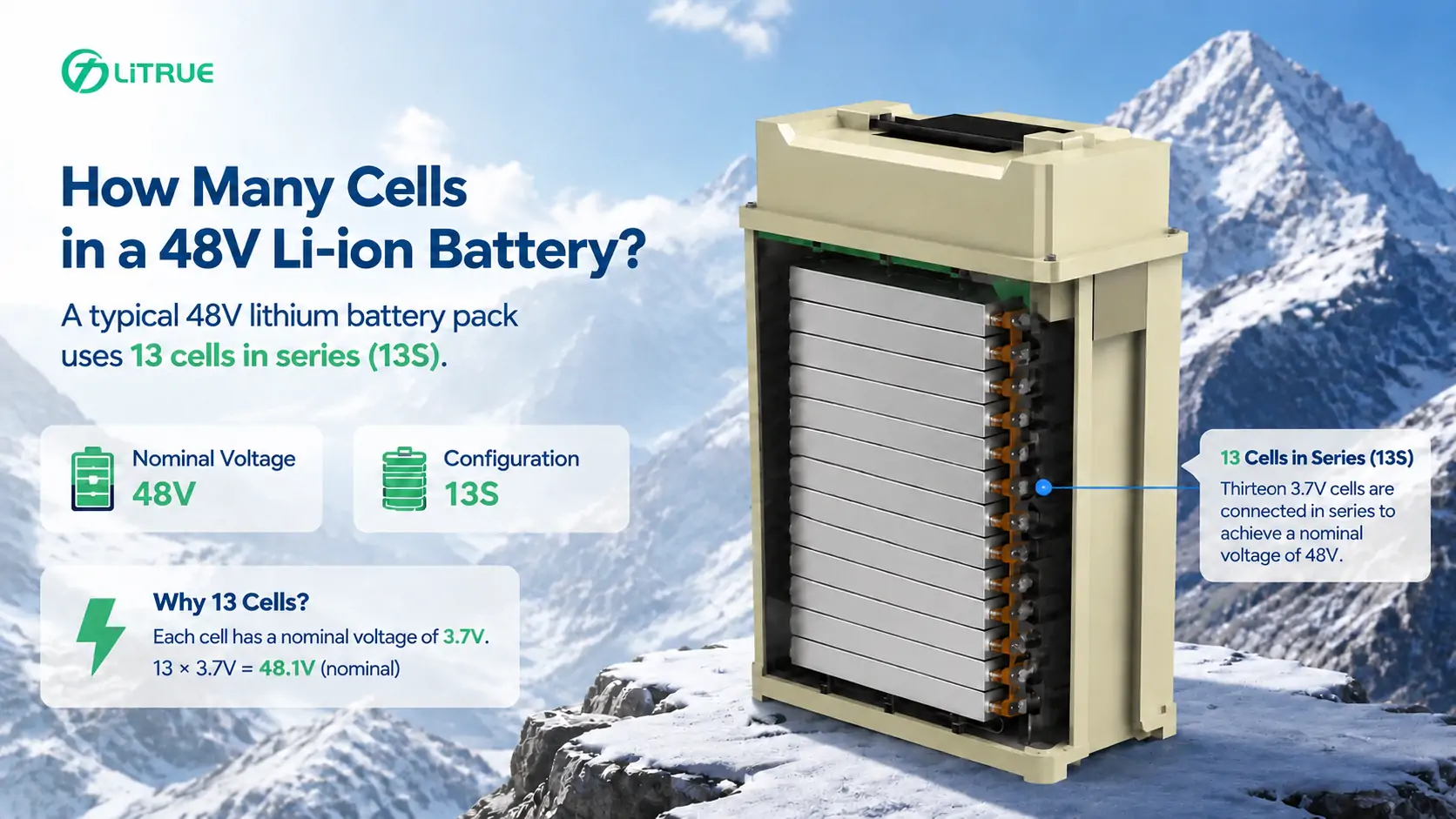
This is simple series math once you know the nominal cell voltage: series count = target pack voltage ÷ nominal cell voltage. The catch is that "48V" is a nominal marketing label, not the pack's actual resting voltage, and the answer changes with chemistry.
The UAV-JP330L pack above is a clean real-world illustration of this math: it uses an NMC cell at 3.70V nominal, wired 18 in series (1P18S configuration), which gives 18 × 3.70V = 66.6V nominal — exactly the pack's rated voltage. No parallel strings, since 1P means capacity comes from a single 30Ah cell (or cell group) per series position rather than multiple cells wired side by side.
Applying the same math to a 48V target: for LFP (3.2V nominal per cell), 48V ÷ 3.2V = 15 cells in series (15S), giving 48.0V nominal. In practice, many "48V" LFP packs actually use 16S (16 × 3.2V = 51.2V nominal) to leave more usable capacity above the low-voltage cutoff — so a "48V" LFP pack being 51.2V nominal on the label is normal, not a labeling error. For NMC (3.6–3.7V nominal per cell), 48V ÷ 3.7V ≈ 13 cells in series (13S), giving roughly 48.1V nominal.
Parallel count is a separate variable that sets capacity, not voltage — a 15S4P LFP pack has the same nominal voltage as a 15S1P pack, just four times the amp-hour capacity and four times the cell count. Total cell count is always series × parallel.
Why BMS and Module Balancing Matter
Cells in a series string are never perfectly identical — small manufacturing variances in capacity and internal resistance mean each cell charges and discharges at a slightly different rate. Left alone, that gap compounds over hundreds of cycles: the weakest cell in the string hits its voltage limit first, and the BMS has to stop the whole pack early to protect it, even though the other cells still have capacity left. That's capacity loss you never actually reasoned your way into — it's just accumulated imbalance.
Balancing exists to correct that gap. Passive balancing bleeds off excess charge from the stronger cells as heat until the weaker cells catch up — cheap, common, and adequate for most UAV and light industrial packs. Active balancing shifts charge between cells rather than wasting it, which recovers more usable capacity but adds cost and circuit complexity, and tends to show up in larger BESS and EV packs where every percentage point of capacity has more dollars behind it.
Beyond balancing, the BMS is also the pack's protection layer — overcurrent, overvoltage, undervoltage, and thermal cutoff all live here. The UAV-JP330L's spec sheet lists exactly this: overcharge, over-discharge, and over-current protection with an alarm, plus CAN communication so the flight controller can read that status directly. A cell or module without a BMS isn't a safety risk by itself, but a pack without one is a pack that has no way to stop itself when something goes wrong.
Which Structure Is Better for UAV and Industrial Batteries?
There isn't a universal answer — it depends on what the application is optimizing for. UAV batteries are optimizing for grams: every module housing, connector, and extra wire run is mass the aircraft has to lift on every flight. That's why most drone packs, including the UAV-JP330L, go straight from cell to finished pack — 18 NMC cells wired directly into a single series string at pack level, with a compact BMS handling protection and balancing across the whole string, skipping the module layer entirely.
Industrial and stationary applications — AGVs, forklifts, BESS — are optimizing for serviceability and scale instead. A module that can be pulled and replaced without disassembling the whole pack is worth the extra weight when the pack lives on a shelf or a slow-moving vehicle rather than in the air. This is also where module-level thermal management and standardized mechanical footprints pay for themselves across large production runs.
LiTrue builds both patterns depending on the application — direct cell-to-pack assemblies like the UAV-JP330L for UAV and light industrial packs, built from high-rate cells like the PA50N-P, and module-based architectures where the end use calls for it. If you're not sure which structure fits your application, that's a sizing conversation worth having before committing to a BOM.
FAQ
Is a battery pack the same thing as a battery module?
No. A module is a sub-assembly — a fixed group of cells in a housing, sometimes with basic monitoring. A pack is the complete, deployable product: cells or modules plus a full BMS, harness, connectors, and enclosure. A pack is always built from modules or cells; a module is never itself the finished product.
Can a battery pack skip the module layer and use cells directly?
Yes. This is the standard approach for UAV and many light industrial packs, where weight matters more than modular serviceability. The UAV-JP330L is a real example — 18 cells wired directly into a single series string, with the BMS handling balancing and protection across the whole string rather than per module.
How many cells are in a 48V lithium-ion battery?
It depends on chemistry: roughly 13 cells in series for NMC (3.6–3.7V nominal per cell), or 15–16 cells in series for LFP (3.2V nominal per cell). The same math scales to any target voltage — the UAV-JP330L's 66.6V pack uses 18 NMC cells in series (18 × 3.70V = 66.6V). Total cell count also depends on parallel count, which sets capacity rather than voltage.
What does balancing battery modules mean?
It means actively equalizing the charge level across cells in a series string so the weakest cell doesn't hit its voltage limit before the others, which would otherwise cut the pack's usable capacity short. Passive balancing bleeds excess charge as heat; active balancing redistributes it between cells.
What is a BMS and does every pack need one?
A battery management system (BMS) monitors and protects the pack — overcurrent, overvoltage, undervoltage, and thermal cutoff — and typically handles cell balancing. Any finished pack intended for real-world use should have one; the UAV-JP330L, for example, includes overcharge, over-discharge, and over-current protection with CAN communication. A bare cell or module generally does not carry this, since protection is the pack level's job.
Talk to LiTrue Engineering Team
If you're scoping a pack — whether that's a direct cell-to-pack UAV build like the UAV-JP330L or a module-based industrial design — our team can help you work through series/parallel sizing, BMS requirements, and certification before you commit to a BOM. Reach out to our engineering team to talk through your application.