
With the rapid development of the global low-altitude economy, drone battery play a crucial role in the flight process for commercial and industrial drone operators. During high-altitude operations, standard batteries often fail to meet the task requirements. At this time, professional drone lithium battery solutions are needed to address the power consumption issue of drone.
At LiTrue, we’ve spent over 15 years in the trenches of lithium-ion engineering. We’ve seen hundreds of drone projects struggle because the power system was an afterthought. This guide isn't just a list of products; it’s a technical breakdown of how high-energy density NMC chemistry and smart engineering can finally solve your payload-endurance bottleneck. Backed by 60+ in-house patents and 230+ global partnerships, we’re here to show you what "lightweight" actually means in a professional industrial context.
Table of Content
- Overview
- Product Deep Dive: The UAV-JP220M 51.8V 20Ah Battery
- Alternative of Comparison: NMC vs. LFP for Drones
- FAQ
- Summary
Overview
In the drone world, energy density (Wh/kg) is the only metric that truly dictates your ROI. Many off-the-shelf packs claim "high performance," but they lack the cell-level consistency needed for 1000+ cycles. Here is the truth you won't hear from trading companies: a battery that is 100g lighter but has 20% higher internal resistance will kill your flight time through heat loss (Joule heating).
Our engineering team focuses on NMC (Nickel Manganese Cobalt) chemistry because it currently offers the highest energy-to-weight ratio for commercial aviation. By utilizing a 1P14S configuration with Tier-1 Grade A cells, we achieve energy densities that allow your aircraft to stay airborne longer without sacrificing safety. Speaking of safety, every pack we ship is tested against GB/T 38930-2020 standards—ensuring that "lightweight" never means "fragile."
Product Deep Dive: The UAV-JP220M 51.8V 20Ah Battery
Unique Selling Points
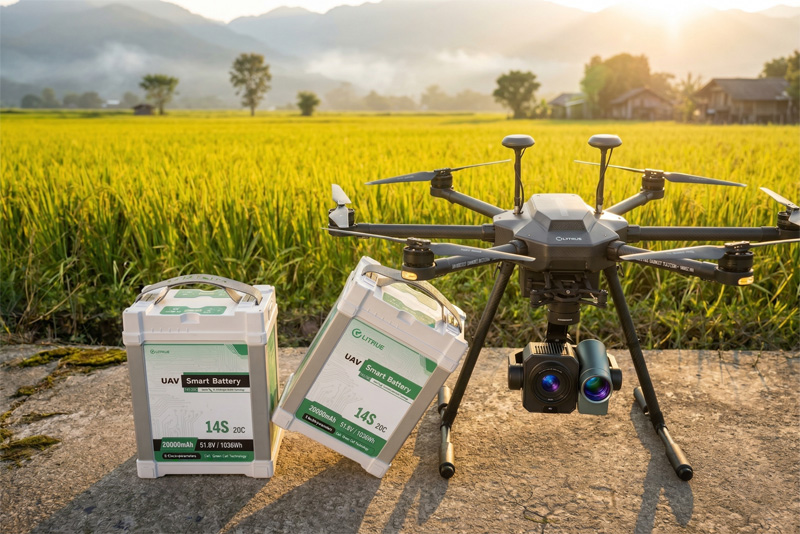
The UAV-JP220M isn't just another battery pack; it's a precision-engineered flight component.
Audience Intent Match
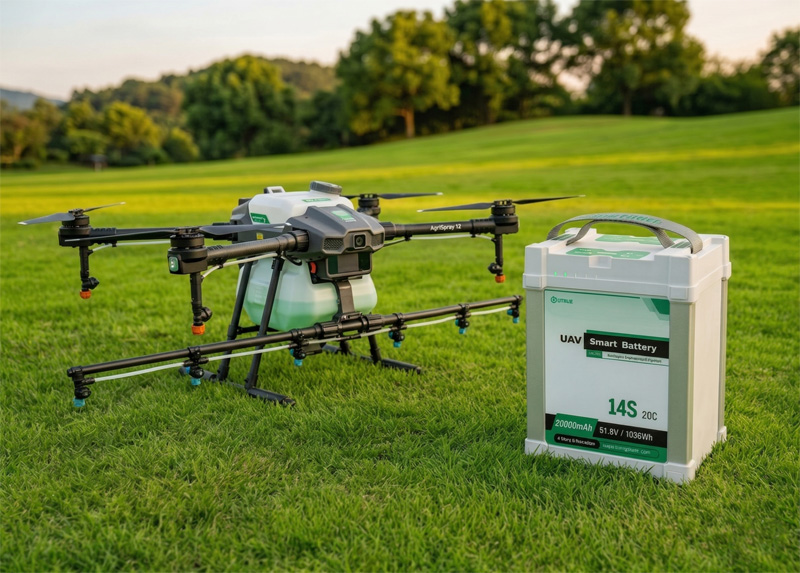
Who this is for: Professional drone manufacturers (OEMs) and operators who need to maximize LiDAR or multispectral camera uptime. It’s perfect for the DJI T-series type of heavy-lift agricultural platforms or custom mapping birds. Who this is NOT for: Casual hobbyists or FPV racers looking for 2-minute "punch" batteries. This is a sustained-power industrial tool designed for longevity and fleet reliability.
Performance Evaluation
When evaluating a lightweight pack, you must look at the C-rate. The UAV-JP220M supports a 50A continuous discharge and a 100A peak (30s). For a 20Ah battery, that is a solid 2.5C/5C rating. In real-world agricultural spraying, this means you can perform aggressive maneuvers even when the tank is full without the voltage sag that triggers "low battery" alarms prematurely. Our internal tests show a cycle life of ≥1000 at 1C/1C—roughly 2-3x better than generic "pouch" packs.
Design & Usage
The compact footprint (172 × 110 × 245 mm) is designed for a low center of gravity. We’ve integrated a Smart BMS with CAN bus communication. This isn't just for protection; it allows your flight controller to "talk" to the battery in real-time, providing millisecond-accurate data on SoC (State of Charge) and cell health. The IP65 rating means you can operate in the dusty, humid conditions typical of pesticide spraying without worrying about short circuits.
Customization
Need a different connector? Or a vertical vs. horizontal orientation? Backed by 15+ years of OEM experience, our engineers can customize the casing, the BMS communication protocol (SMBus, CAN, RS485), and even the cell chemistry to match your specific aircraft weight limits. We translate your CAD drawings into physical power solutions faster than anyone else in the industry.
Limitations
Let's be honest: NMC chemistry has its limits. While the energy density is superior, it is more expensive than LFP (Lithium Iron Phosphate). If your application doesn't care about weight (e.g., ground-based robots), an LFP solution would provide better cycle life at a lower cost. Also, the UAV-JP220M requires a dedicated high-voltage charger to reach its 40A fast-charge potential.
Pros & Cons
- Pros: Unrivaled Wh/kg ratio (152 Wh/kg at pack level); IP65 all-weather protection; CAN bus integration for smart flight control.
- Pros: Wide operating window (-40°C to +60°C); 1000+ cycle life (high ROI).
- Cons: Higher upfront cost compared to standard LFP; Requires specialized charging equipment for peak efficiency.
Similar Products
For those needing even more capacity, we offer the UAV-JP330L, a 30Ah variant that maintains the same high-rate performance but scales up for 25kg+ payload missions. Alternatively, for hybrid drones, our 6C High-Power Pouch Cells offer the pulse current needed for engine-start assistance.
Alternative of Comparison: NMC vs. LFP for Drone
Choosing the right lightweight battery often comes down to this battle:
FAQ
Q: How much flight time can I gain by switching to a high-density NMC pack?
A: On average, our clients see a 12-20% increase in flight endurance when upgrading from standard LiPo packs to our NMC UAV series. This is due to both lower pack weight and better voltage stability under load.
Q: Is the battery safe for international shipping?
A: Absolutely. All LiTrue Battery products are UN38.3 and MSDS certified. We handle the complex compliance paperwork to ensure seamless delivery to your facility via air or sea freight.
Q: Can the BMS be integrated with my proprietary flight controller?
A: Yes. Our Smart BMS supports CAN communication. Our technical team will work with your engineers to ensure the protocol mapping is 100% compatible with your system telemetry.
Summary
In the competitive landscape of commercial UAV, the battery is no longer just a consumable—it is a strategic asset. By choosing a lightweight high-energy density UAV battery pack like the LiTrue UAV-JP220M, you aren't just buying power; you are buying payload capacity, mission safety, and long-term operational efficiency.
With 15+ years of engineering expertise, 60+ patents, and automotive-grade automated production, LiTrue is your source for professional power. Don't let a heavy, inefficient battery ground your project’s potential. Invest in engineering that takes you further.
