
Search "lithium battery cell manufacturer in china" and you'll get thousands of listings that all claim to be premium, leading, and world-class. None of that tells you whether the factory can actually hold ±2mV cell-to-cell consistency across a 10,000-cell batch, or whether the "manufacturer" you're emailing is a trading company relaying your spec sheet to three different plants. For a buyer sourcing cells for a real product — a drone, an e-bike pack, a BESS unit — the wrong choice doesn't show up until month six, when a field failure rate that looked fine on paper turns into a warranty problem.
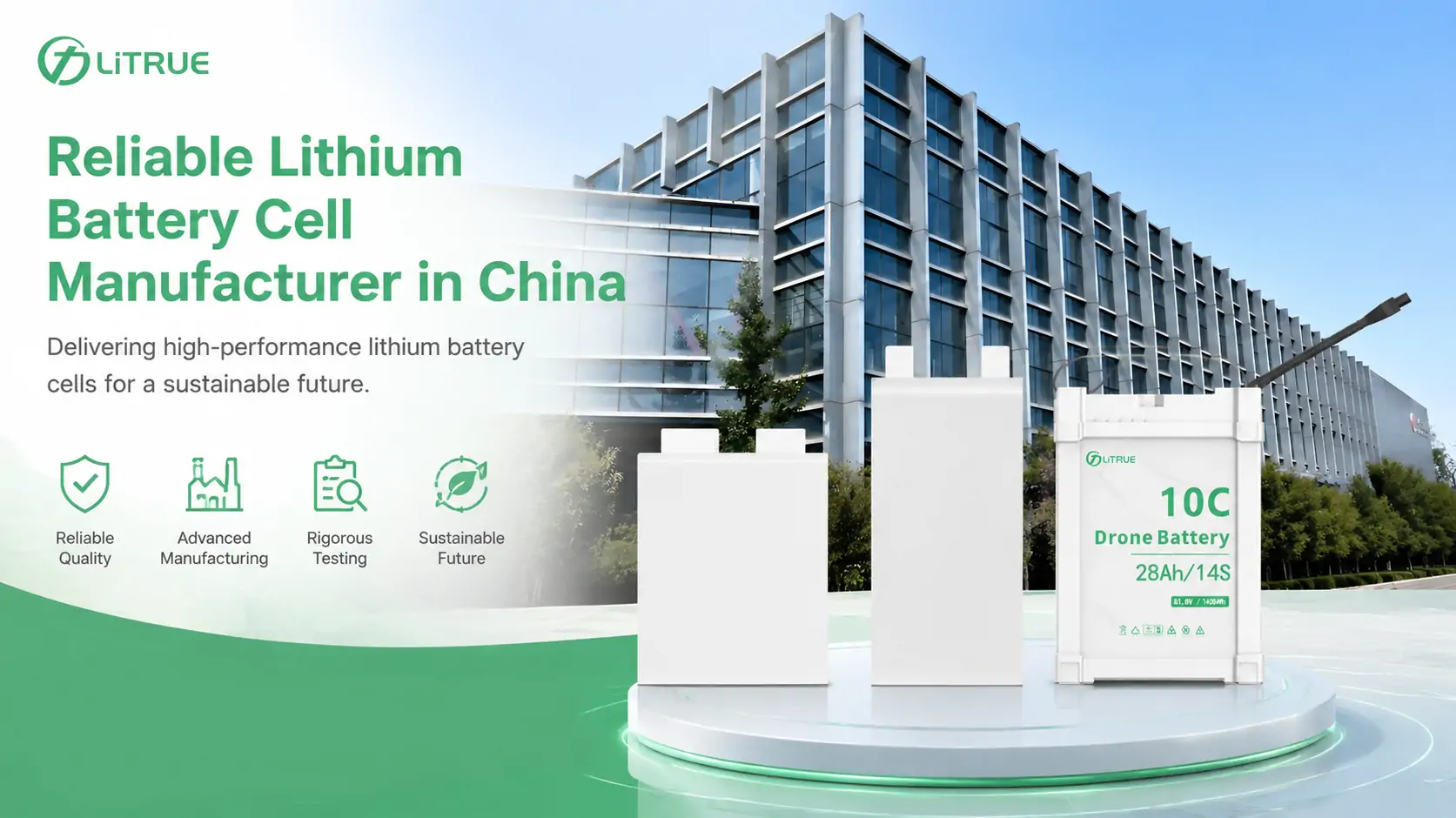
This guide walks through what actually separates a dependable supplier from a risky one, and what to check before you commit to a purchase order.
Start With Manufacturing Reality, Not the Sales Deck
China's battery supply chain has three distinct layers: cell manufacturers who own the coating, winding/stacking, and formation lines; pack assemblers who buy cells and build them into finished battery packs with a BMS; and trading companies who resell either without owning production. Among the b2b manufacturers and suppliers of lithium-ion batteries in china, only the first group can actually control cell-level quality — everyone downstream inherits whatever consistency (or inconsistency) came out of that plant.
Ask directly: which factory makes the cell, and can you visit or get a video audit of the production line? A real manufacturer will answer in one sentence. A trading company usually pauses, then says they'll "check with the factory."
Match Chemistry to the Application, Not to Whichever Cell Is Cheapest
Most sourcing mistakes start here. LFP (lithium iron phosphate) and NMC cells solve different problems, and a supplier who pushes one chemistry regardless of your use case is optimizing for their inventory, not your product.
- LFP: longer cycle life, better thermal stability, lower energy density. The right call for BESS, forklifts, e-buses, and anything where cycle count and safety margin matter more than shaving off grams.
- NMC: higher energy density in a smaller footprint, shorter cycle life. Better fit for drones, e-motorcycles, and portable devices where weight and range are the constraint.
The same chemistry decision also affects finished products such as portable power stations and residential energy storage systems. For example, Piforz develops integrated energy storage solutions that consider cell safety, cycle life, capacity consistency, BMS compatibility, and power requirements at the system level.
If you're specifically evaluating lifepo4 cell manufacturers in china, narrow the list further by asking for actual cycle-life test data at your target C-rate and depth of discharge — a cycle-life number quoted at 0.2C and 80% DoD will look very different from your real-world 1C, 100% DoD usage.
Certifications and Testing You Should Actually See
A cert badge on a website means nothing without the report behind it. Ask for the actual test reports, not just a logo.
| Standard | What it covers | Why it matters |
|---|---|---|
| UN38.3 | Transport safety testing for lithium cells | Required for international air/sea freight — no report, no shipment |
| GB/T 38058-2019 | Cell design and safety requirements (China) | Baseline safety standard for cells sold in or made in China |
| GB 31241-2022 | Safety requirements for portable electronic device batteries | Relevant for consumer and light-EV applications |
| UL 2054 / IEC 62133 | Battery safety, US/international | Often required for products sold into the US/EU market |
| RoHS | Restriction of hazardous substances | Standard requirement for most export markets |
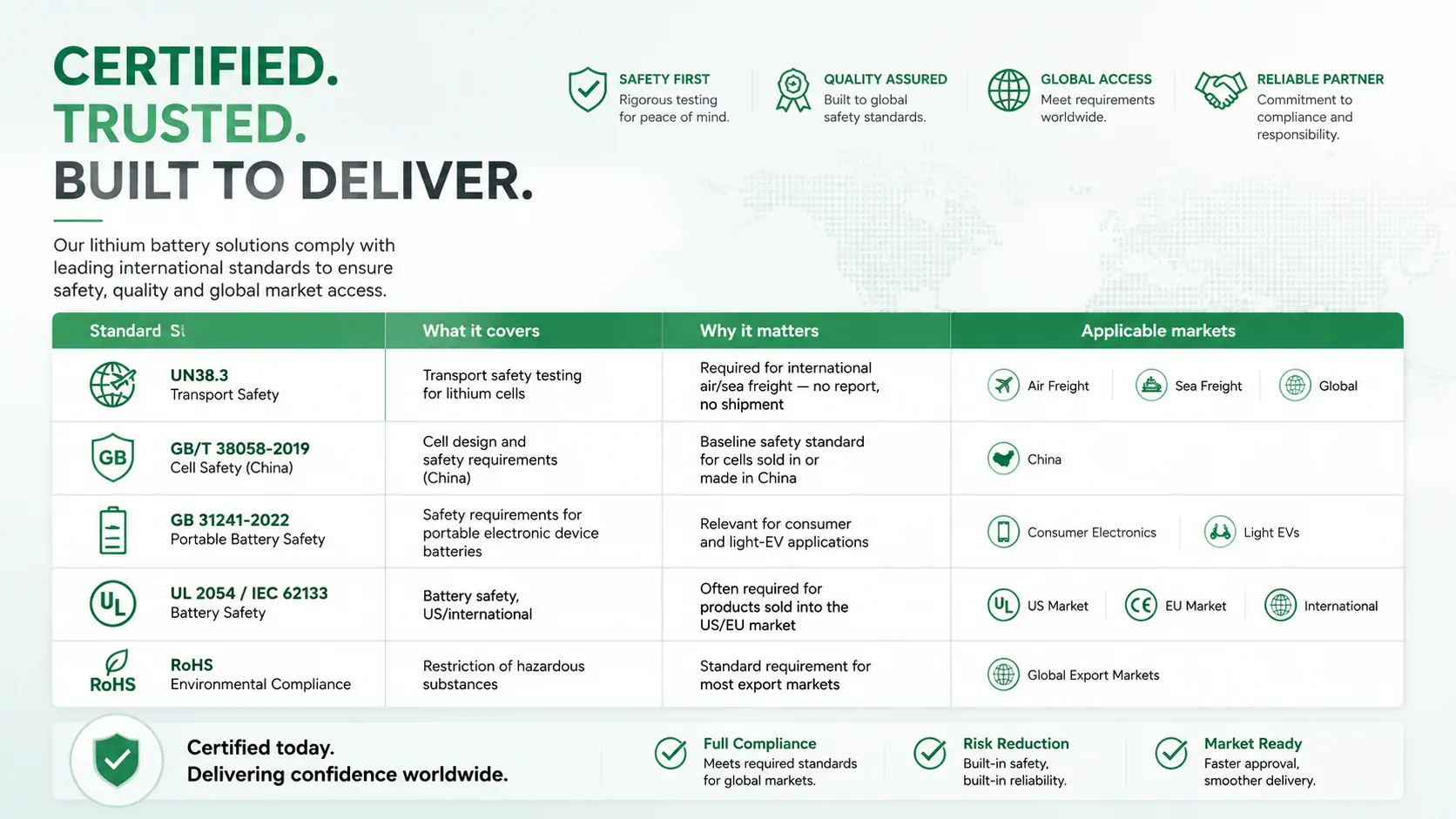
Note: applicable certifications vary by cell format, capacity, and destination market — confirm which ones apply to your specific model rather than assuming a supplier's general catalog claims cover your case.
MOQ and Customization: Where Most Buyers Get Stuck
Established cell factories are often built around large-format contracts, which makes them a poor fit for startups, R&D teams, or anyone validating a new product before scaling. If you're searching for a low moq pouch lithium battery manufacturer, the real question isn't just "what's your minimum" — it's whether the supplier has a genuine small-batch or pilot-run process, or whether they'll quote you a low MOQ and then miss the delivery date because your order got deprioritized behind a 50,000-unit customer.
A supplier set up for flexible pouch cell production — supporting custom dimensions, capacity, and tab configurations at sample and pilot-run quantities — signals that small orders are a real part of their business, not an exception they tolerate. See our pouch and prismatic cell range for the kind of capacity and format spread this typically requires.
Consistency Is the Metric That Actually Predicts Field Performance
Two cells with identical datasheets can behave completely differently in a pack if their internal resistance and capacity vary batch to batch. This is what causes premature cell imbalance, BMS faults, and shortened pack life — and it almost never shows up in a single-cell spec sheet.
Before committing to volume, request a small sample batch and check:
- Capacity spread across the batch, not just the average.
- Internal resistance (IR) consistency — wide IR variance is the earliest signal of an unstable production line.
- Actual cycle-life data at your real operating conditions, not the vendor's best-case test setup.
Communication, Lead Time, and After-Sales Support
A cell manufacturer's responsiveness during the RFQ stage is a preview of how they'll behave once you have a production issue. Slow, vague answers to technical questions before you've placed an order rarely improve after you have.
Worth confirming upfront: typical lead time for samples versus production runs, whether they offer technical support for pack integration (BMS matching, protection circuit design), and how warranty claims or failure-analysis requests are actually handled — not just what the contract says, but whether they've done it before.
A Quick Red-Flag Checklist
- Can't confirm which factory physically produces the cell.
- No willingness to share actual test reports, only marketing certificates.
- Pushes one chemistry regardless of your stated application.
- Quotes a low MOQ but can't describe a small-batch production process.
- Cycle-life numbers with no stated test conditions (C-rate, DoD, temperature).
FAQs
What's the difference between a cell manufacturer and a battery pack assembler?
A cell manufacturer controls the actual electrochemical production — coating, winding or stacking, electrolyte filling, formation. A pack assembler buys finished cells and builds them into a battery with a BMS, connectors, and housing. If cell-level quality is your concern, you want to be sourcing from the manufacturer directly, not a downstream assembler.
Is LiFePO4 always safer than NMC?
LFP has better thermal stability and a wider safe operating margin, which is why it's the default for stationary storage and heavy-duty applications. That doesn't make NMC unsafe — a well-designed NMC cell with proper BMS protection is standard across drones and e-motorcycles worldwide. The right choice depends on whether your application prioritizes energy density or cycle life and thermal margin.
How low can MOQ realistically go for custom pouch cells?
It depends on the format and how close the spec is to an existing production line. Sample and pilot-run quantities are generally achievable when a supplier already runs flexible small-batch lines; a fully custom dimension or capacity from scratch will carry a higher minimum than an adjustment to an existing cell design. Ask for a specific number against your exact spec rather than a general "low MOQ" claim.
What documents should I ask for before placing a first order?
UN38.3 test report, relevant safety certification reports (not just logos), a cycle-life test report with stated test conditions, and — if available — a capacity/IR consistency report from a recent production batch. These four documents tell you more than any spec sheet.
How do I verify a supplier's manufacturing claims without visiting China?
Ask for a live video audit of the production line, request batch-specific (not generic) test reports, and start with a small sample order before committing to volume. A supplier confident in their process will accommodate all three without pushback.
Have a specific cell requirement or want to see current lead times and sample pricing? Reach out to our engineering team — we'll walk through chemistry, format, and MOQ options against your actual application.